


Everyone in fusion agrees the magnets are hard. Where the industry tends to focus, though, is on performance — peak field, quench behavior, tesla records — while the question that actually decides commercial viability sits one layer down: can you manufacture these things at a cost and complexity that makes the plant economics work? That’s the question Victor Prost has spent his career at Renaissance Fusion answering. His background is well suited to it: an engineering degree in France, then a PhD at MIT in mechanical engineering focused on structural optimization and machine design — exactly the disciplines that determine whether a fusion magnet can actually be built, and at what cost. He joined Renaissance as the fusion startup wave was taking off, working first on system codes before leading the development of the company’s laser-engraved HTS magnets and the manufacturing tools behind them.
Throughout our conversation, one thesis kept resurfacing: the path to commercial fusion runs through manufacturing simplification, and the company that makes stellarator magnets buildable wins something much bigger than a physics argument.
I. The Vertical Integration Bet: Why Solve Three Problems at Once
Renaissance Fusion is attempting something that looks, at first glance, like a violation of startup orthodoxy. Rather than picking one hard problem, they’ve taken on three: a simplified stellarator design, wide-format HTS manufacturing with laser-engraved magnets, and liquid metal walls to handle heat and neutron flux. Most fusion companies pick one, maybe two. When I pressed Victor on why three in-house is the right bet rather than a distraction, his answer started with an uncomfortable claim about the rest of the field:
“The traditional stellarator technologies that people are actually targeting right now — yes, they’ll make the first fusion machine, but these designs will not be economical. If you think of other standard companies and look at the size of the proposed machine or the cost of the machine, it’s tremendous. There’s a high likelihood that it will work — but will it be commercially viable? That’s another question.”
This is a distinction the industry doesn’t spend enough time on. There is a meaningful gap between demonstrating fusion and commercializing it, and the capital markets have a habit of conflating the two. First-of-a-kind machines are, almost definitionally, uneconomical — W7-X cost on the order of billions to build and outputs are measured in research value, not competitive megawatt-hours. Renaissance’s position is that the technologies they’re developing aren’t incremental improvements to that paradigm; they’re an attempt to change the cost structure of the machine itself.
The second half of the answer is the one I find more strategically interesting, because it reframes vertical integration as a hedge rather than a burden:
“You cannot build a fusion ecosystem if you don’t have the supply chain. Developing key technologies ourselves meant that we were part of the supply chain — we’re building a supply chain that would be useful for us, but it’s also a moat, because not all fusion companies will succeed, but the ones that do will need a fusion supply chain. It’s a way for us to secure the company’s future, and also to get early revenues before the fusion machine.”
Read that carefully, because it’s a subtly different thesis than the one most fusion integrators are running. Renaissance isn’t just betting that their machine works. They’re betting that fusion works — somebody’s fusion — and positioning themselves as critical infrastructure for whoever wins. If the stellarator succeeds, they own the full stack. If it doesn’t, they’re still one of the only companies on the continent that can produce HTS at scale. In a sector where binary technical risk is the defining feature of every cap table conversation, engineering a non-binary outcome is genuinely differentiated. It rhymes with what CFS has done with its magnet business — most recently with Realta — but Renaissance is pushing the logic further down the stack, all the way to the tape itself.
When I asked what Renaissance needs from the European ecosystem to actually deliver, Victor’s diagnosis was blunt on the capital point and specific on everything else:
“What we need the public sector to focus on is building strategic infrastructure — fusion test facilities — because those are things that won’t generate revenue, but everyone needs them, and they’re high capital cost. Test facilities for looking at aging of materials under irradiation: those are the things the public sector should focus on. The private sector is well suited for industrialization — taking the research and scaling it up.”
The division of labor here is worth underlining: governments should build ecosystems and shared infrastructure, not run integrator programs, and private companies should do the industrial scaling that bureaucracies structurally cannot. Victor adds two items to the public-sector list that deserve more attention than they get — workforce development (Europe has only a handful of dedicated fusion university tracks) and regulatory harmonization across member states, where countries have currently chosen divergent paths. A continental fusion industry with 27 regulatory regimes is not a continental fusion industry.
II. Wide or Bust: The MOCVD Decision
To understand Renaissance’s technical strategy, you have to start with a manufacturing choice most coverage skips entirely: how the superconducting layer gets deposited. The majority of the HTS industry has historically relied on pulsed laser deposition — PLD — for REBCO deposition and Victor was refreshingly candid about why:
“PLD was the easier from a process point of view and to handle at industrial scale, for the simple reason that it doesn’t involve chemicals reactions with thin film deposition. People who were doing thin-film deposition in the semiconductor industry — it was easier for them to transition to PLD rather than dealing with huge chemical plants. That’s why a lot of companies favored PLD. But the issue with PLD is that it’s hard and not cost-effective to scale up in terms of size. Most of the companies implementing it are sticking to the 4–12-millimeter tape.”
Renaissance went the other way, choosing MOCVD — metal-organic chemical vapor deposition — and accepting the chemistry headache in exchange for a geometric advantage:
“MOCVD lends itself very well to doing wide-format deposition. That’s the reason why we chose MOCVD: because it can enable wide deposition areas — almost a meter. And to date, MOCVD is the process that was able to produce the longest HTS tape at narrow width. So that’s the other reason — to have wide and long HTS tape.”
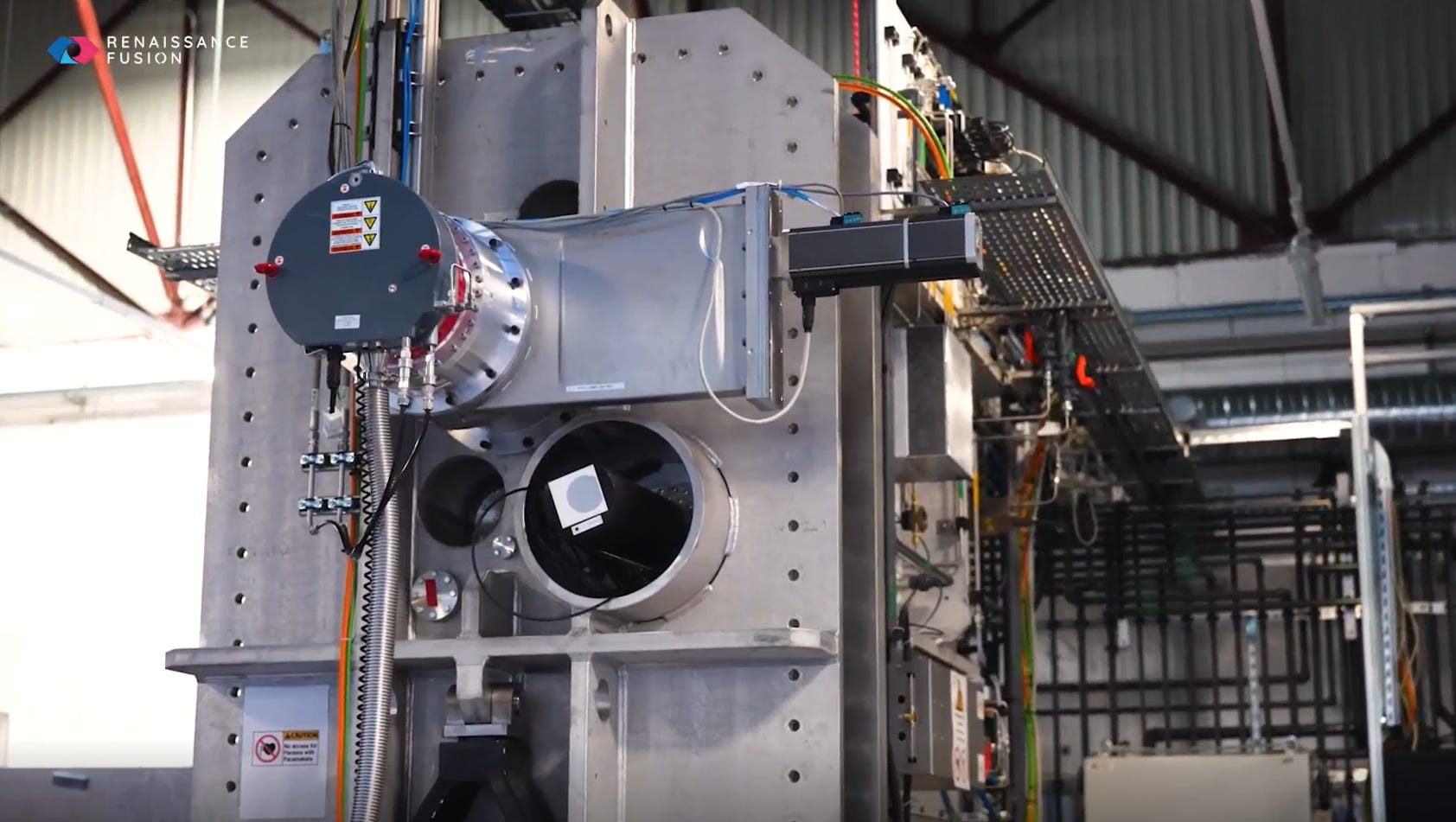
The strategic logic here is worth spelling out, because it’s the foundation everything else rests on. The entire global HTS industry is organized around 4–12-millimeter tape. Every magnet architecture, every winding technique, every cost model assumes you’re working with narrow ribbons that get stacked and wound. Renaissance is betting that this is a local optimum — an artifact of which deposition process was easiest to industrialize, not of what fusion magnets actually want. If you can deposit superconductor across a meter-wide foil, you stop thinking about tape as a wire substitute and start thinking about it as a surface — which is exactly what a stellarator’s continuous, sculpted magnetic fields would prefer.
There’s also a hard economic claim attached. When I asked about cost drivers in the magnet stack, Victor put a number on the wide-format advantage:
“Magnets are one of the most expensive parts in fusion machines, and today a lot of the cost of those magnets comes from the HTS. In our case, we have this new approach of having wider deposition areas, which will reduce the manufacturing cost by almost 50% compared to other HTS manufacturers.”
This sits inside one of the more underappreciated dynamics in fusion — the HTS price curve. Tape has fallen as production capacity has scaled, but most manufacturers are driving cost down by building more of the same narrow lines. Renaissance is attacking from a different axis: changing the geometry of production itself. If the 50% claim holds at industrial scale, it’s not just a fusion story; it’s a claim on every superconducting application waiting for HTS to reach LTS-competitive price points. And it would be a European claim, in a market currently dominated by Japanese and Chinese producers — a sovereignty point I’ll return to.
III. Transferring Complexity from Steel to Software
The second pillar — and the one I’d argue is Renaissance’s most original contribution — is laser engraving. The idea: instead of winding narrow tapes into precisely machined 3D coil structures, you take wide HTS foil, engrave the current paths into it with a laser, and wrap it around simple cylindrical formers. Victor was careful to scope where this matters:
“If you talk about a standard solenoid, there’s no real benefit from the laser-engraving technology — simple magnet structures aren’t very complex. But when you start looking at complex field generation — magnets for gyrotrons (plasma heating systems), or stellarator magnets — then the 3D shape kicks in, and that’s where costs start to skyrocket.”
And then he quantified the prize:
“If we think of a stellarator magnet, today the cost of machining the structure, just for the magnets, is maybe 30, 40% of the magnet cost. Our idea, by going through laser engraving, is to transfer the complexity from the structure to the laser path. Engraving a complicated path with the laser is not very complicated. So that’s how we’re able to have complex fields with a simple magnet — going from something that’s taking 30, 40% of the cost towards something that’s only like 10%.”
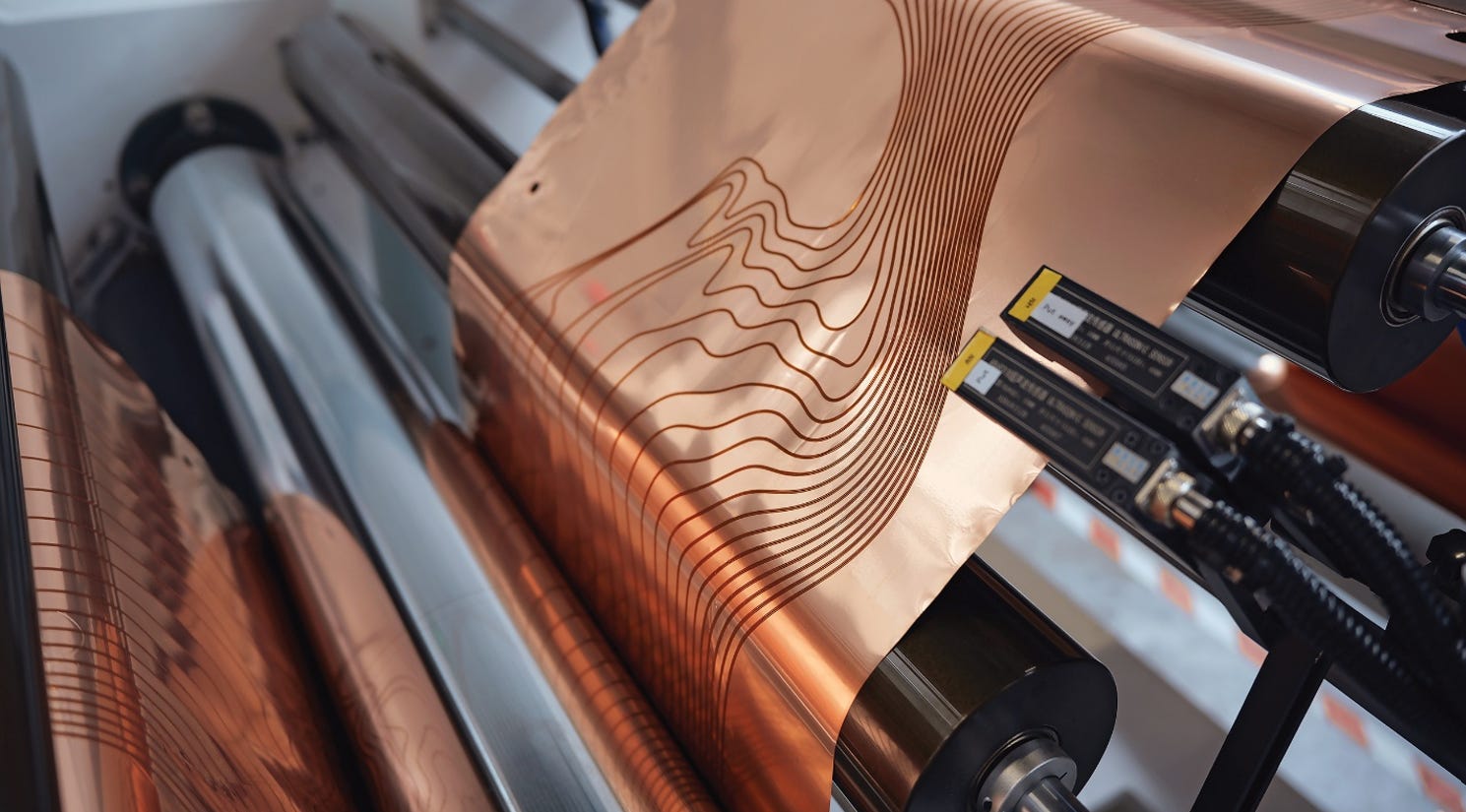
Transfer the complexity from the structure to the laser path. That single sentence is, to me, the entire company. Stellarators have historically been the “right answer, wrong decade” of fusion — better physics than tokamaks (steady-state operation, no disruptions, no current drive) purchased at the cost of nightmarish 3D engineering. W7-X’s coils became famous as much for how hard they were to build as for what they achieved. Renaissance’s answer is essentially a software answer: make the hardware simple and the pattern smart. Complexity that lives in a laser toolpath is versionable, iterable, and nearly free to change. Complexity that lives in machined steel is none of those things.
There’s a second-order benefit that Victor flagged, and it’s one I hadn’t fully appreciated before this conversation — the structural argument:
“Magnet strength is not limited by HTS tape today. It’s limited by the structural material that holds the magnet together. If we think of the magnet done by the Plasma Science and Fusion Center in collaboration with CFS, they hit the structural limit while they still had plenty of margin on the HTS tape. If you want stronger fields — which means smaller machines — you need a stronger structure. And a 3D-shaped structure is really hard to support, rather than a simplified one. That’s why the engineering limit for a simplified stellarator magnet is pushed further away than for a 3D-shaped magnet.”
This deserves to be more widely understood. The famous CFS/MIT 20-tesla-class demonstration didn’t exhaust the superconductor — it exhausted the steel. Which means the frontier of compact fusion isn’t a materials-science problem in the tape; it’s a mechanical engineering problem in the structure. Renaissance’s simplified cylindrical geometry isn’t just cheaper to machine — it’s easier to hold together under load, which pushes the achievable field (and therefore how small the machine can be) further out.
IV. What the Demonstrators Actually Prove
Claims are cheap in fusion; hardware is not. So I spent a good portion of the conversation on what Renaissance has physically built and measured — and the answers were refreshingly concrete.
The deposition line. Renaissance has built its full HTS manufacturing line in-house — a standard seven-layer stack architecture requiring six machines:
“Those six machines have been designed, built, and are installed in-house. So far, we have turned on four out of the six and have shown that four out of six are working. We’re able to commission them separately, because you can buy tape that has all the layers except the one you want to deposit — so you can test machines even if you don’t have the full process there. Once we’ve done the remaining two — which we aim to do before the end of the year — we’ll do the full stacking in-house.”
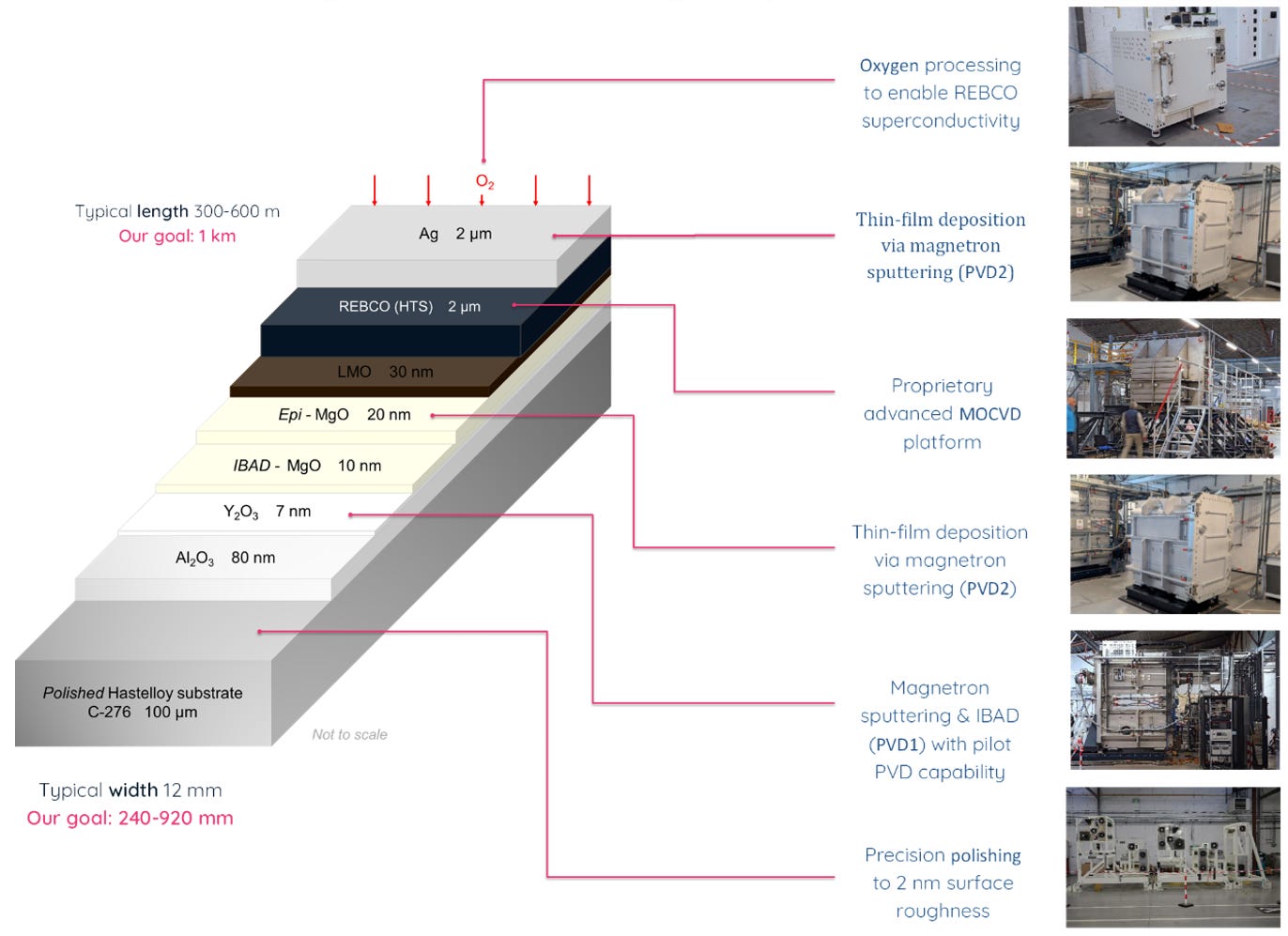
The commissioning detail is clever and worth noting: by buying partially completed tape from other suppliers, each machine gets validated independently rather than waiting on a full end-to-end process. And the width matters — these machines are being commissioned on 24-centimeter foil, a twentyfold increase over the industry-standard 12 millimeters, as a stepping stone toward the meter-wide target. The layer stack itself is deliberately conventional (”the layers we deposit are not something we invented”): the innovation budget is spent on width, not chemistry.


The high-field magnet. The six-tesla peak-field magnet, operated at 20 K in a non-insulated, quench-resilient architecture, behaved almost exactly as modeled — and the most telling result came when they deliberately pushed it past its limits:
“We had a quench margin of around 20% — the nominal operating current was 20% below the predicted current where we would see the transition to non-superconducting material. We pushed the magnet a bit more, and yes, the magnet lost superconductivity, as expected — within 5% of the margin we had estimated. Thanks to the non-insulated architecture, it was able to dump the energy into resistive losses inside the magnet, not shed it to a hot spot that would melt and break the magnet. After that quench, we were able to cool it down again, repower the magnet, and recover most of its performance.”
A magnet that quenches within 5% of prediction and survives is two results in one: the models are trustworthy, and the architecture is forgiving. For anyone thinking about the operational reality of a power plant — where a quench can’t be a machine-ending event — the second result is arguably the more commercially important one.
The engraved copper stellarator. Because meter-wide HTS foil doesn’t exist yet, the laser-engraving track runs in parallel on copper laminates — and the precision numbers are striking:
“The first one we built was an MRI-scale magnet, and we were able to reach precision on the order of tens of ppm — parts per million — in terms of field accuracy. That’s several orders of magnitude better than what you need for a stellarator magnet. On the software side, the pattern-generation tools allowed us to be on the order of 0.1% off the target field; after building the device, we were on the order of a percent, once you encounter all the manufacturing errors. The idea is that by next year, we’re building the next iteration of magnets to get better field accuracy.”
Note the honest gap: 0.1% in simulation, ~1% as-built. That delta between designed and manufactured field is exactly the kind of number serious hardware companies track obsessively — they’re measuring it, they’re open about it in conversation, and they have a plan to close it by an order of magnitude. On the scaling question — whether the 10-micron engraving precision survives industrialization — Victor’s answer was structural: because it’s a roll-to-roll process, every meter of foil passes through the same laser enclosure regardless of how large the final magnet is. The precision is a property of the machine, not the magnet. You engrave small, then wind large.
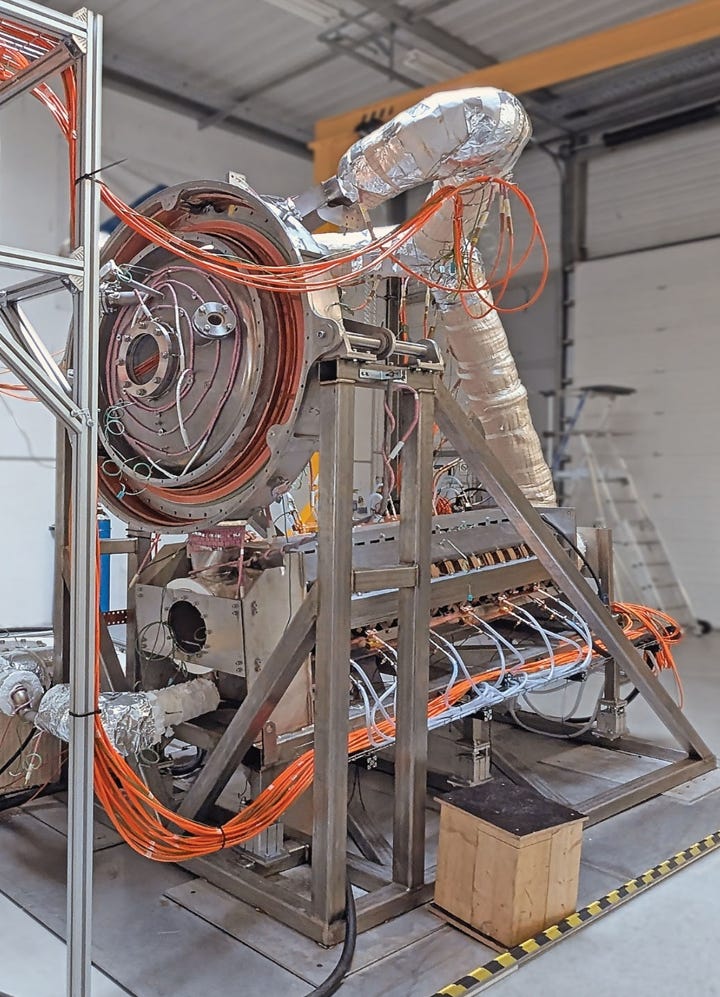
The road ahead. The near-term sequence is legible: complete the HTS pilot line (revenue and raw material), build a large-scale high-field laser-engraved HTS magnet, stand up a lithium liquid-metal loop (the pumping technology already proven on tin at 700°C, running centimeters from a 20 K magnet — a thermal-gradient result that quietly de-risks one of the least explored interfaces in fusion), then integrate the two. Tritium breeding and neutron shielding run as a separate demonstrator headed to the Astral facility in the UK and its 14 MeV neutron source, for the simple reason that neutron sources are hard to come by. Each rig moves the company one step closer to reactor operating conditions before a reactor exists.
V. Selling Tape Before Selling Power
The commercial strategy is where Renaissance’s supply-chain thesis stops being abstract. The sequencing Victor described is pragmatic for this industry:
“On the HTS fusion market, what we’re trying to get is conditional purchase orders from other fusion companies — because everyone needs HTS tape, but the current global production capacity is not sufficient. Other markets include HTS current leads, superconducting R&D (magnetic screening), and superconducting cables. We know that our first batch of HTS tape will not be fusion grade; but will be able to address some other markets like HTS current leads, or wide HTS R&D . So that’s a way for us to get revenues and enter the market with HTS with lower critical‑current specifications, while we continue advancing toward fusion‑grade performance.”
It would be easy to gloss over the fact that a first batch won’t be top-spec; Victor volunteers it and shows you the business model built around it. Alternative markets such as HTS R&D tapes or HTS current leads will help build credibility and fund the climb to fusion-grade tape. Meanwhile, a laser-engraved undulator demonstrator is underway for synchrotrons such as the ESRF next door in Grenoble — a small project whose real product is proof, to the external world, that Renaissance has customers.
On IP, the structure is a deliberate two-layer defense — 15 patents covering the wide-deposition machine designs, the laser patterning, and the stellarator architecture, wrapped around a core of trade secrets:
“Everyone knows the layers that are in the tape, but the process parameters to use the machines and produce the tape — that’s the secret sauce. That’s something we’ll keep internal, similar to the laser parameters we’re using to engrave the tape without damaging or reducing its current-carrying capacity.”
It’s the classic posture of serious hardware companies: patents on the architecture, secrecy on the process. In hardware, the recipe is the moat.
And then there’s the sovereignty dimension. When I asked Victor to map the European landscape, his inventory of continental HTS capacity was short:
“Right now there aren’t a lot of European manufacturers or suppliers of the critical technologies. In terms of HTS production, there isn’t a large one — there’s THEVA in Germany, but they don’t have a lot of capacity, and they don’t do a lot of fusion-grade tape. And there’s Suprema, an Italian HTS startup pushing towards traditional narrow-tape manufacturing, but it’s still early-stage. So it’s about securing production of core technologies in Europe, instead of relying on non-European suppliers — having a bit of sovereignty in the infrastructure.”
This is the gap in the European fusion story. The continent’s leading integrators have made supply-chain Europeanization an explicit strategic goal — but a goal like that is only achievable if companies like Renaissance actually exist to source from. Europe currently has world-class fusion science, a handful of credible integrators, and almost no domestic HTS capacity at fusion grade. If the continent is serious about fusion sovereignty, the tape layer is where the money needs to go — and right now Renaissance is one of very few companies positioned to receive it.
Two closing observations from the conversation stuck with me. First, the regulatory geography: France has yet to tailor its nuclear framework to fusion the way Germany and the UK have, which is part of why Renaissance opened an Italian entity last year — a quiet signal that European fusion companies are already arbitraging regulatory regimes within the single market, which is precisely the fragmentation Victor flagged as a public-sector priority to fix. Second, the grid argument for stellarators, delivered almost as an aside: because the machine is continuous rather than pulsed, there’s no need for load-following buffers or storage systems to smooth the output. A stellarator plugs into the grid the way a fission plant does. It’s a small point with large balance-of-plant implications, and it’s part of why — as I told Victor — I remain bullish on stellarators as the steady-state platform even if a tokamak like SPARC crosses Q>1 first.
If there’s a broader pattern here, it’s this: the European fusion companies worth watching are the ones that treat manufacturing as the product. The plasma physics is largely inherited — from W7-X, from decades of public science. What’s new is the industrial thesis: that fusion becomes commercial when its most complex components become simple to make. Renaissance has staked the entire company on that proposition, one meter-wide foil at a time.
A genuine thank you to Victor for the time — it’s rare to get someone this deep in the hardware who will give you real numbers, honest gaps between model and machine, and the strategic logic behind every technical choice. Thoroughly enjoyed it.
— Gabriel